UNC Pembroke Celebrates Graduate Class Ready to Lead and Serve
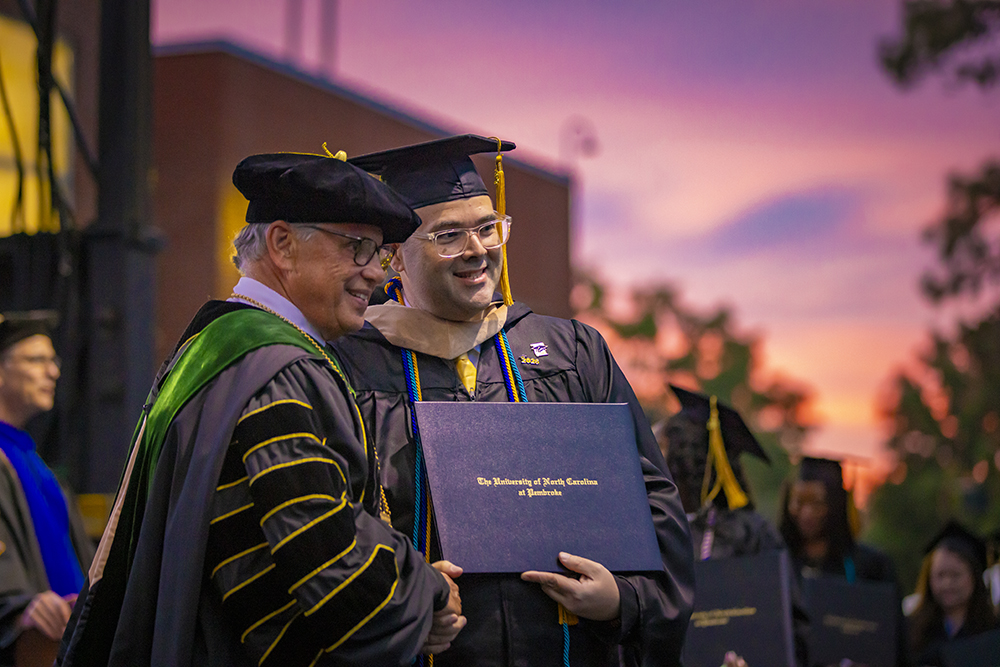
UNC Pembroke celebrated 517 graduates Friday evening, honoring a class of educators, healthcare professionals, business leaders, military members and public servants prepared to take the next step in their careers and communities.
Their paths to commencement were as diverse as the degrees they earned. They came from hospital floors, classrooms, military service, leadership offices and communities where earning a graduate degree means more than adding another line to a résumé. For many, the walk across the stage was a promise kept.
That spirit carried through UNCP’s William Howard Dean Graduate School commencement ceremony on May 8, where family members, faculty, staff and friends gathered to celebrate students who pushed through long workdays, personal loss, academic setbacks and seasons when finishing was not guaranteed.
Dr. John Herrington , a former NASA astronaut, retired U.S. Navy aviator and citizen of the Chickasaw Nation, delivered the commencement address. Herrington, who became the first enrolled citizen of a Native American tribe to fly in space, spoke less about the view from space and more about what it takes to keep climbing when life does not follow the plan.
He told graduates he once struggled in college and was suspended after his first year. A mentor convinced him to return, a decision that changed the direction of his life.
“Your struggles are temporary; your success is permanent,” Harrington said.
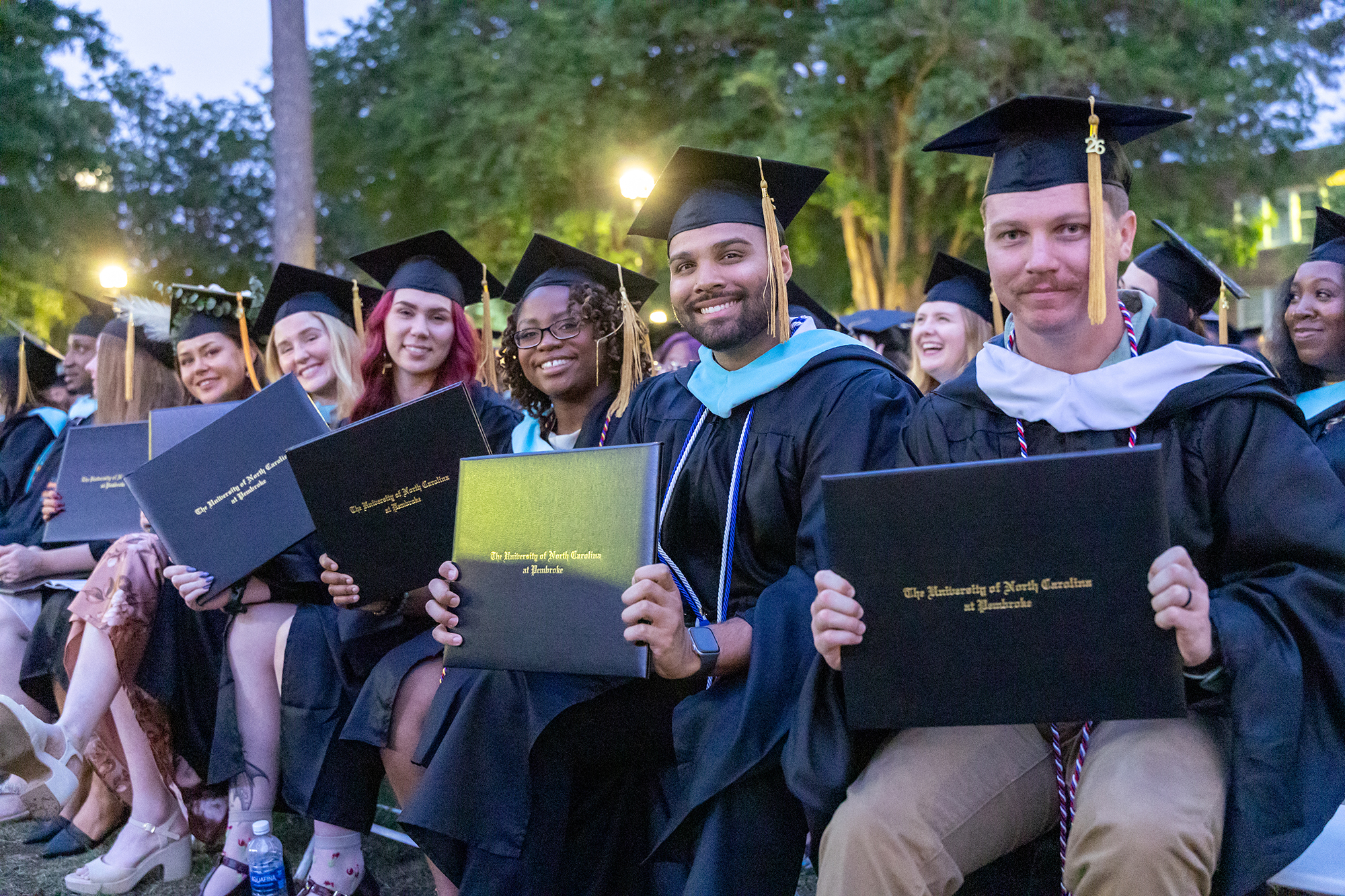
It was a fitting message for graduates who knew something about perseverance, including Tedward L. Frazier, whose master’s degree marked the fulfillment of a promise years in the making.
Frazier, who earned his Master of Social Work , served in the U.S. Army and U.S. Marine Corps, with deployments to South Korea, Afghanistan and Iraq. His military experience gave him a deep sense of purpose in helping others, but his mother, Shirley J. Frazier, helped shape the path he would eventually follow.
She worked as a geriatric social worker, and after she died in 2021, Frazier promised at her burial that he would follow in her footsteps.
On Friday night, he did.
“This trip has been both positively demanding and incredibly rewarding,” Frazier said. “I wish my mother could accompany me on this journey and watch her son keep his word.”
Frazier hopes to continue serving veterans and their dependents through macro social work, policy and planning or higher education.
Asia Tilley and Bobbi Godsey, both MSN graduates, said the program shaped the way they see leadership, patient care and their role in preparing the next generation of nurses.
Tilley, now a clinical nurse IV leader at Duke University, said the program strengthened her confidence, clinical judgment and ability to advocate for patients and colleagues.
“The program helped me view patient care through a broader lens,” Tilley said, “by emphasizing teamwork, clear communication and the ways healthcare systems influence outcomes.”
For Godsey, who hopes to teach and mentor future nurses, the program helped her find her voice as an educator, even as she pushed through grief after losing her father midway through her studies.
“This program didn’t just grow my knowledge,” Godsey said. “It strengthened my confidence, my voice and my belief that I truly belong in this role.”
Other graduates carried their own stories of persistence and purpose into the ceremony.
Shaina Platt, who earned her Master of Arts in Teaching , will return to her art classroom with a stronger sense of what art can give students beyond a finished project.
Her time at UNCP deepened her belief that students should have room to explore, make choices and trust their own ideas. In her classroom, that belief has already taken shape through a ceramics project where students created 576 bowls and raised more than $1,500 for local food distribution charities.
James Stevens, an active-duty Army service member who earned his Master of Arts in Sport Administration , used his graduate research to examine work-life balance for women coaches in the NCAA. His leadership philosophy, shaped by military service and ROTC, is simple: develop leaders who can carry the work forward.
For Daniel Leonard, who earned his MBA while balancing an executive role, family responsibilities and a career move, graduate school was not separate from the work he was already doing. It sharpened how he approached strategy, data and leadership in real time.
“It’s very easy to do difficult things when you have your priorities straight and go to work each day with a mission of servitude in mind,” Leonard said.
Together, their stories reflected the broader meaning of Friday’s ceremony. These graduates were not only finishing their degrees — they were preparing to return to their hospitals, schools, military units, businesses and communities with more knowledge, more confidence and a clearer sense of purpose.
Herrington urged them to carry that purpose with gratitude. He recalled being advised during a spacewalk to stop and take in the moment, not for a photograph, but for memory. Looking out over Earth from the International Space Station, he said he felt both small and responsible.
That responsibility, he told graduates, now belongs to them too.
“Honor those that came before you and help to make this world a better place,” Herrington said.
The next chapter, he reminded them, is not something waiting to happen on its own.
“The future doesn’t just happen to you,” he said. “The future begins with you.”